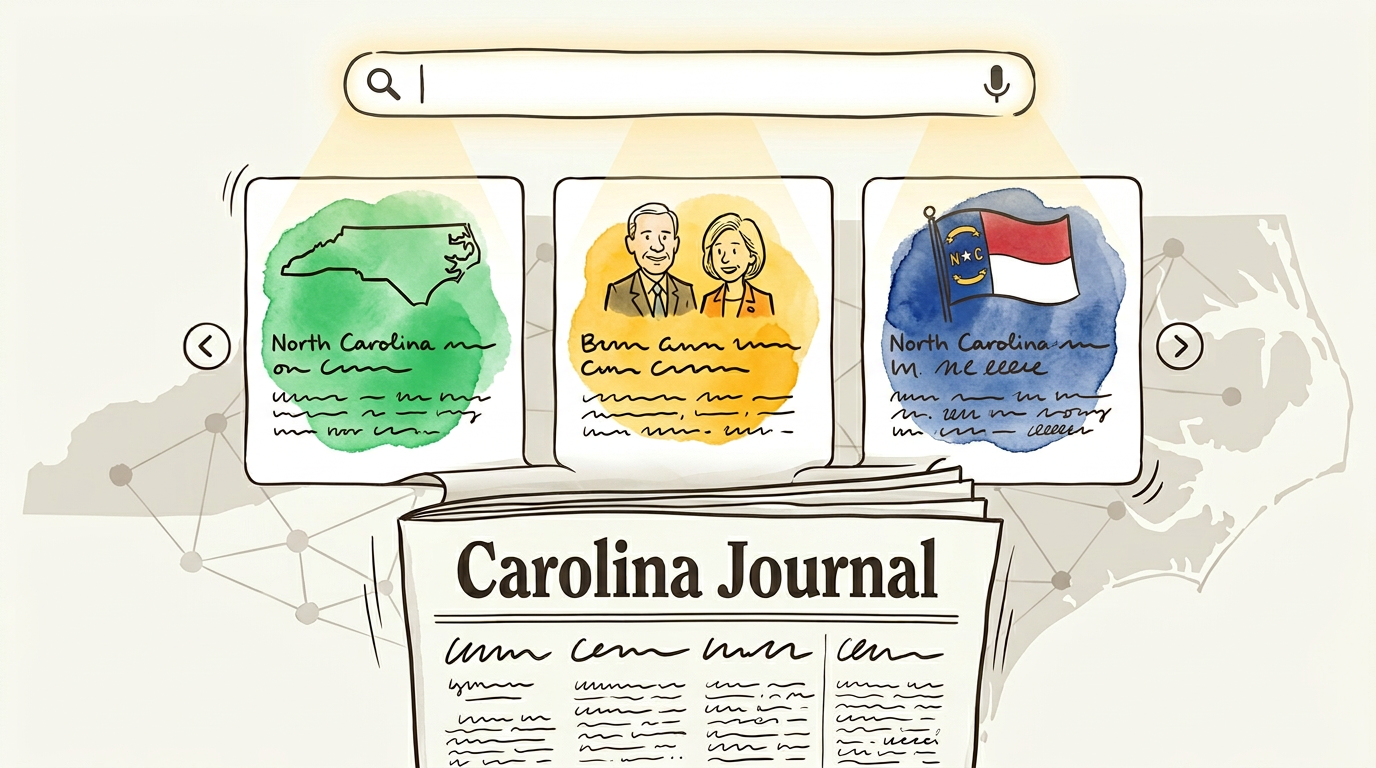

One Carolina Journal opinion piece, a review of the 2022 eco-terrorism film How to Blow Up a Pipeline, sat at position 52 in Google. For the keyword that matched its exact subject, a keyword searched 12,000 times a month, it was effectively invisible, buried five pages deep behind film critics, activists and the movie’s own marketing pages.
Six months after Carolina Journal activated TopicalBoost on their WordPress site, that same article ranked at position 1. No new content, no fresh backlinks, no republish. Google simply understood, for the first time, what the article was actually about.
That is what topical authority looks like in practice, and it is the pattern that explains a much bigger story hidden in Carolina Journal’s data over the last six months.
The news publisher’s SEO gap
State-focused news publications like Carolina Journal sit in a structurally tough position. They publish on news cycles they do not control, they cannot do keyword research on a breaking state budget story, and they compete with CNN, Fox, local TV stations and the aggregators (Google News, NewsBreak, Apple News) for every click on every story.
The traditional SEO plugins like Yoast or RankMath optimize around keywords but don’t help Google understand what an article is about, what institutions it covers, or what policy domains it touches.
Editors write fast, ship fast and hope the story finds its audience.
The result is exactly what you would expect. Great journalism gets buried. Top Stories carousels, the boxes that appear at the very top of Google’s search results for news queries, go almost exclusively to national outlets and local TV. At the same time, a regional news publication shows up on page 2 for a term their article perfectly answers.
That was the baseline Carolina Journal lived with before we turned on TopicalBoost in September 2025.
What changed over six months
The single most consequential shift was their presence in Google’s Top Stories carousel. In the six months before activation, Carolina Journal appeared in Top Stories 22 times, roughly four times a month. In the six months after activation, they’ve appeared 106 times, nearly 18 times a month. That is a nearly five-fold increase, driven not by a news-cycle spike, but by Google’s willingness to surface more of their stories in more news-query contexts.
The breakdown matters. Of the 106 appearances, 34 were at position 1 in the carousel, 37 at position 2 and 19 at position 3. A total of 83 unique Carolina Journal pages appeared, with a combined search volume exposure of 2.9 million monthly searches.
Some of the moments are worth naming:
- “8 congressmen, 38 legislators face Super Tuesday challenges” held position 1 in Top Stories for 25 hours on a keyword searched 744,000 times a month.
- “Stein, Causey call on Congress to help Outer Banks homeowners” held position 1 for 7.6 hours on a 421,000-volume keyword.
- A UNC COVID records story held position 1 for 27.7 hours.
- A news story on election integrity activist Cleta Mitchell held position 2 for 51.8 hours, the longest unbroken stretch of the period.
Every one of those appearances is a story that would not have surfaced in Top Stories before TopicalBoost. The Knowledge Graph did not know that a Carolina Journal piece about the UNC Board of Governors belonged in the same conversation as a CNN piece on higher education policy. It does now, because the plugin made the connection explicit.
The keyword story underneath
Top Stories appearances are the headline metric, but keyword movement is the proof that something structural shifted.
This shows up two ways depending on how you measure. Ahrefs, which tracks a finite universe of keywords with measurable search volume, shows Carolina Journal owning 845 keywords in Google’s top three positions at the six-month mark, up from 658 at the same point a year earlier—a 28% year-over-year increase in the hardest, highest-value ranking tier.
Google Search Console, which records every query Google actually showed the site for, tells a stronger story. Carolina Journal averaged a top-3 position for 6,020 distinct queries in the 28 days ending the six-month mark, up from 2,623 a year earlier—a 129% year-over-year increase.
The gap between those numbers is the point. Ahrefs measures a fixed keyword universe; GSC measures the actual surface area of queries Google considers your site relevant for. TopicalBoost works precisely by broadening the universe of entity and concept queries Google associates with the site, which is exactly what GSC captures and Ahrefs misses. Both numbers grew. The larger one tells you what the structural work is actually doing.
Both numbers also held up in a year when Ahrefs’ broader long-tail visibility collapsed industry-wide. Google removed the &num=100 parameter from search results, breaking most rank-tracking infrastructure. Top-three counts remained reliable in both Ahrefs and GSC because they live on the first page of results, where every tracker can still see them. So a top-3 gain is a real gain, not a tracking artifact.
The movement is not just incremental. A handful of keywords jumped from the middle of page 3 or page 6 directly into the top three:
| Keyword | Monthly Volume | Position Before | Position After |
|---|---|---|---|
| tricia cotham | 11,000 | Not in top 100 | 2.6 |
| unc wilmington | 8,600 | 26 | 1.4 |
| mcadenville | 2,900 | 43 | 1.3 |
| nc state of emergency | 1,900 | 49 | 2.2 |
| valerie foushee | 700 | Not in top 100 | 2.2 |
| trump rocky mount nc | 350 | Not in top 100 | 2.6 |
| mackeys ferry sawmill in north carolina | 60 | Not in top 100 | 2.2 |
| eric rouse kinston nc | 50 | Not in top 100 | 2.8 |
| back the blue bill nc | 40 | Not in top 100 | 1.6 |
| roy cooper poll numbers | 40 | Not in top 100 | 2.6 |
| clemens v. unc signal app subpoena | 10 | Not in top 100 | 1.0 |
These are not commercial keywords, and they are not keywords their editorial team actively optimizes for. They are terms where Carolina Journal already had the best, most thoroughly reported North Carolina-specific answer, and where Google’s Knowledge Graph had no way to recognize that fact. TopicalBoost’s schema.org structured data, combined with automatic internal linking from high-authority archive pages, gave Google the context it was missing.
The honest part
Carolina Journal’s total organic search sessions are down 37% when you compare the six months before TopicalBoost to the six months after (734,024 to 459,675 sessions). I want to say that out loud, because every credible case study should name the numbers that decline, not hide them.
Part of that decline is publishing cadence. Carolina Journal published roughly 13% fewer posts in the post-TopicalBoost window than in the pre-TopicalBoost window, with November 2025 in particular dipping to a 13-month low of 119 posts against a more typical 170 to 200. Fewer fresh stories meant fewer entry points for fresh search queries.
Most of the rest is the defining story of publisher SEO in 2025 and 2026. AI Overviews are consuming clicks that used to reach the top organic result, the 2025 core updates reshaped how news content gets surfaced, and every publisher I talk to is watching raw organic session counts decline. The question for any publisher right now is not whether the tide is coming in. It is. The question is how much ground you hold as the water rises.
Here is where the case for TopicalBoost actually lives, and it is not in the raw session count. Within the organic channel that every publisher is watching shrink, Carolina Journal’s structural position improved on every measurable axis. Their top-3 keyword count grew 28% year over year in Ahrefs and 129% in Google Search Console. Their Top Stories appearances grew nearly five-fold. Average session duration on organic rose 10%, from 135.9 to 149.9 seconds, and engagement rate climbed from 54.3% to 57.9%. During the roughest year organic search has had in a decade, a state-focused news publisher got found more often, held better positions, appeared in more news carousels and held readers longer when those readers did arrive.
That is what stemming the tide looks like. The broader compression is still happening underneath Carolina Journal’s numbers, because no plugin overrides industry-wide changes to how Google surfaces content. What TopicalBoost does, demonstrably, is keep a publisher’s content findable, surface-eligible and engaging in a search environment that is actively working to reduce all three for every publisher who is not doing this structural work.
Why this works mechanically
The mechanism is not mysterious. TopicalBoost runs NLP against every draft inside the CMS editor, identifies the entities mentioned (people, institutions, policies, concepts), and prompts the editor to sort them into Main Topic, About This Post and Also Mentioned.
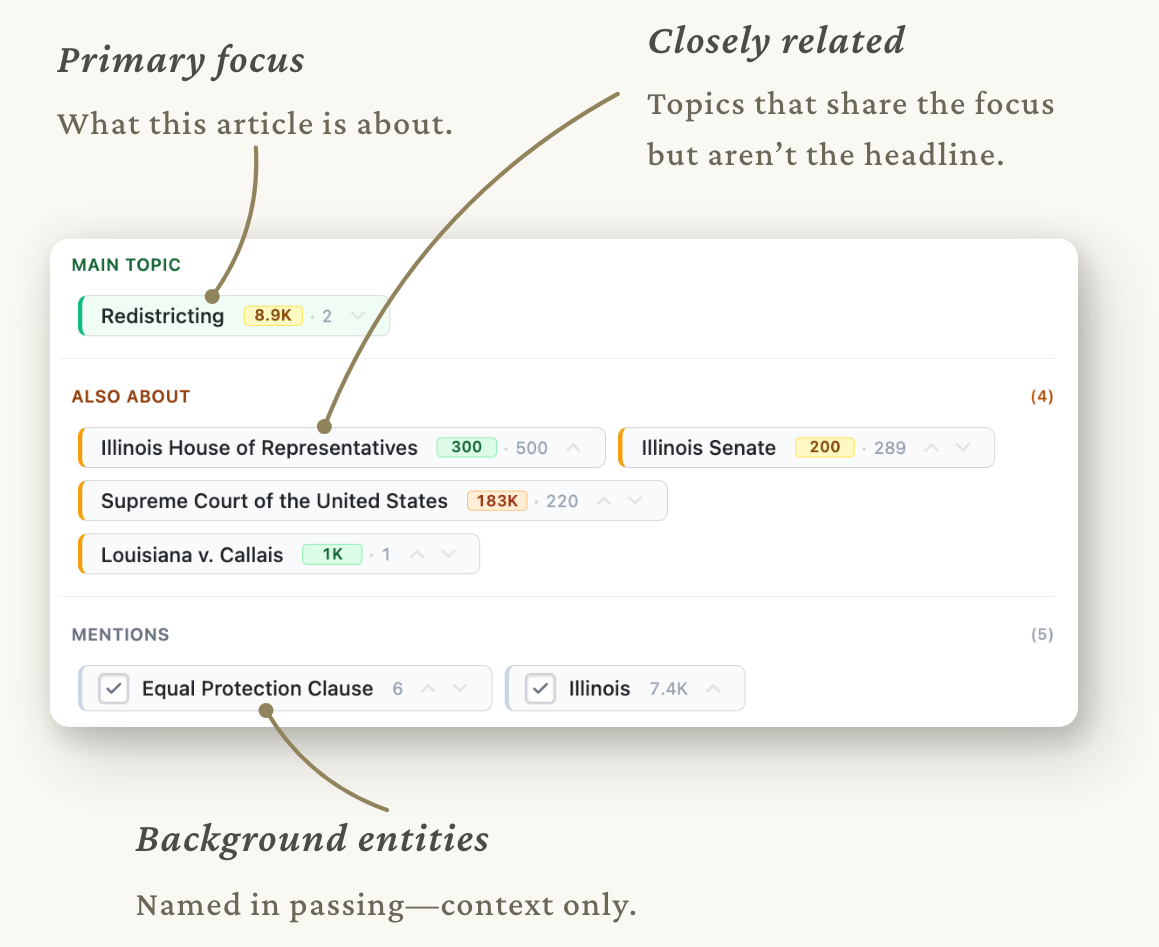
On publish, it generates schema.org structured data that connects the piece to those entities in Google’s Knowledge Graph, and it automatically creates internal links from entity mentions back to topic archive pages on the site. Older, high-authority content redistributes PageRank to newer pieces, and Google gains a vastly clearer picture of what the site covers and how its articles relate to each other.
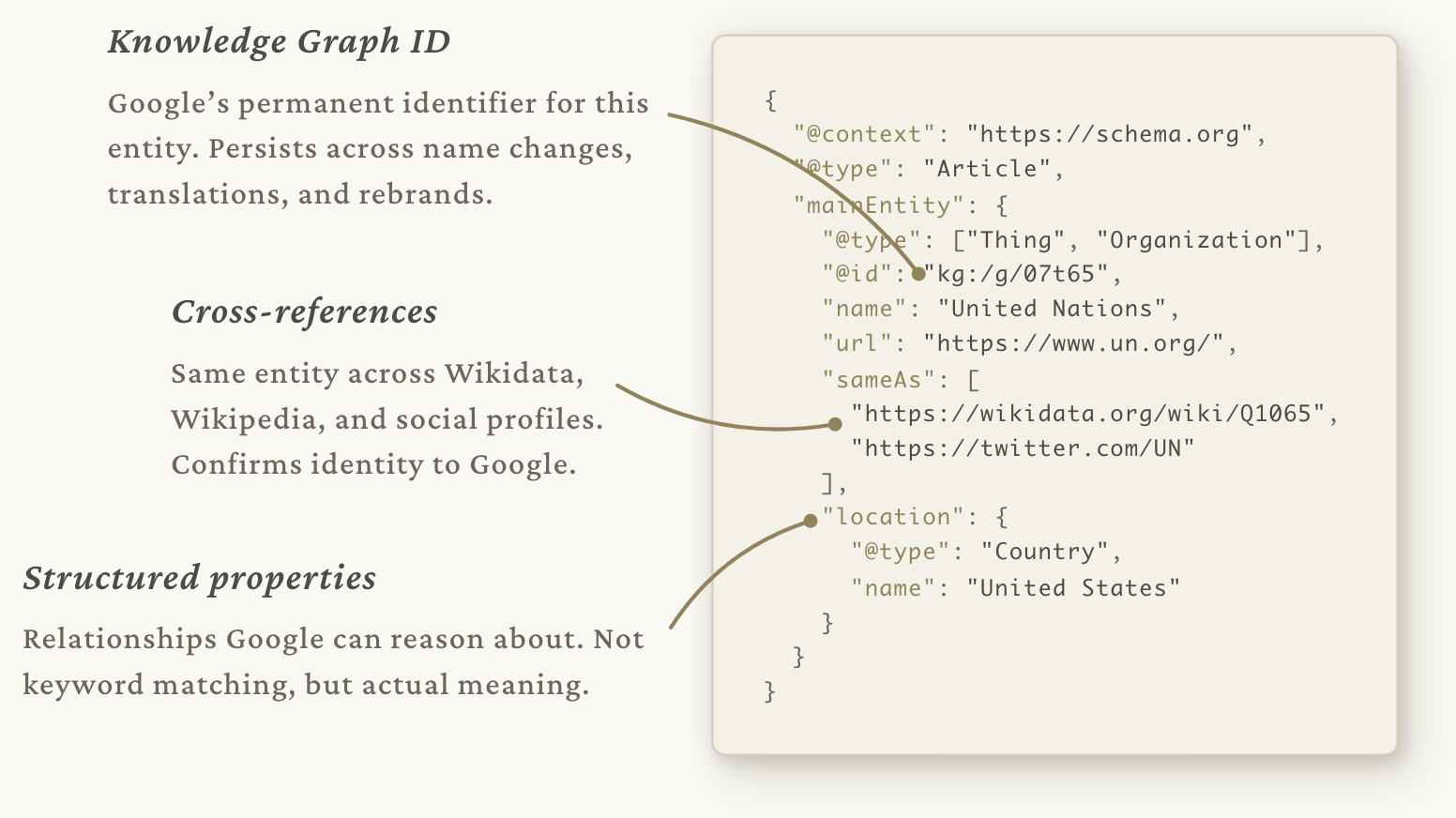
Carolina Journal runs on WordPress. They did not build a custom taxonomy system, they did not hire a dedicated SEO team and they did not retain an agency for ongoing technical work. They installed the plugin, their editors took a short training and they use it consistently on every piece they publish.
What this means for other publishers
If you publish on news cycles, state policy coverage, investigative reporting, editorial commentary or anything where the story matters more than the keyword, your SEO stack is incomplete without the structural layer. The keyword layer is solved. Yoast and RankMath handle titles, descriptions and basic schema, and they do it well. But they do not connect your content to Google’s Knowledge Graph, and that connection is what determines whether your reporting shows up in Top Stories, in Google Discover and in Google News, or whether those surfaces stay closed to you.
Carolina Journal’s results are not a promise of the same specific numbers at every publication. Your traffic mix is different, your entity density is different and your news cycle is different. What the data does say, clearly, is that when a regional news publication connects its content properly to the Knowledge Graph, surfaces that were previously inaccessible open up, rankings on topically relevant queries move toward the top of page 1, and the readers arriving through organic search engage more deeply with the content.
If you are watching your referral traffic decline and wondering what you can still move, the answer is the signals you send Google about what your content is actually about.
Learn more
Search Engine Land, the most cited publication covering the SEO industry, recently deployed TopicalBoost across their 28,000-post archive. Their adoption says more about the approach than any case study I could write. If you want to see what TopicalBoost would identify on your site, book a 20-minute walkthrough and we will run the analysis together.